Come Out of Your Shell
A storytime about turtles
Lesson Plan
The objectives of the lesson are to teach children about turtles, including basic and not-so-basic facts, and introduce the idea that many turtle species are threatened by extinction and need to be protected. Several of the suggested books touch upon themes of conservation and protection.
This lesson plan works well with children in preschool through second grade. The lesson lasts from 45 minutes to an hour, based on the number of books read.
Sing
Begin with your favorite welcome song.
Science Chat
Begin by asking the children what they know about turtles — many children know that turtles have hard shells and usually move very slowly. The following section has some additional facts you can share. Another way to begin the science chat is to ask the children if anyone has a turtle as a pet.
Some amazing turtle facts
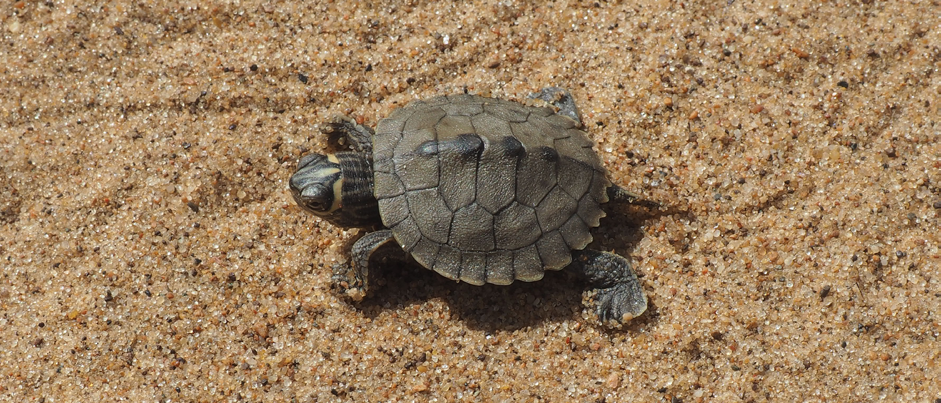
- Turtles are one of the oldest living animals on earth, having existed for 220 million years.
- Turtles are reptiles
- Turtles are cold-blooded (ectotherms) and rely on their environment to heat their bodies.
- There are more than 300 different species of turtles.
- Turtles are intelligent. Some species solve mazes; others learn to use touchscreen technology.
- Turtles can live for a very long time — individuals of certain species can live more than 100 years.
- Turtles come in many different sizes. The speckled Cape tortoise is less than 4 inches long, and the leatherback sea turtle can weigh 2,000 pounds and has a shell that measures up to 6 feet in length.
- Turtles live in many kinds of environments: fresh water, salt water, wetlands, forest, grassland and desert.
- Turtles live on all continents except Antarctica.
- Turtles have shells that help protect them from predators.
- Turtles lay eggs only on land.
- Turtles can be carnivores, herbivores or omnivores.
- The word “turtle” refers to “turtles,” “tortoises” and “terrapins.” Specifically, turtles live mostly in water, tortoises live on land and terrapins live in brackish wetlands.
- Many species of turtles are in danger of extinction. Fifty percent of all species are either vulnerable, endangered or critically endangered according to the International Union for Conservation of Nature (IUCN) and need to be protected.
- Turtles native to Wisconsin and listed as “threatened” or “endangered” may not be kept as pets.
- For the sake of turtles and children, the Humane Society recommends against keeping turtles as pets. Turtles need specialized care, including the right lighting, temperature and water filtration systems. They can live for decades and need room to grow. Additionally, they carry the salmonella bacteria. In fact, selling turtles smaller than 4 inches long has been banned since 1975 in order to prevent the spread of salmonella.
- In Wisconsin, threats to turtles include habitat loss or fragmentation, predators, road traffic, disease, pollution, and the commercial pet trade.
- According to the Turtle Conservancy, humans are the cause and the solution to the extinction crisis. We can help turtles survive by protecting habitats and making agreements to limit human-caused harm.
True or False
A fun way to engage the children is by playing a True or False game about turtles.
| Sea turtles drink salt water | True: All sea turtles drink salt water; they can get rid of the salt by shedding salty tears. |
| Turtles have teeth | False: Turtles have hard, bony ridges on their jaws, instead of real teeth. Depending on the species and where they live, turtles can eat fish, shellfish, ducklings, worms, insects, berries, prickly pear cactus and even sand or soil in order to get more calcium. (See: Turtles [2003] by Deborah Dennard) |
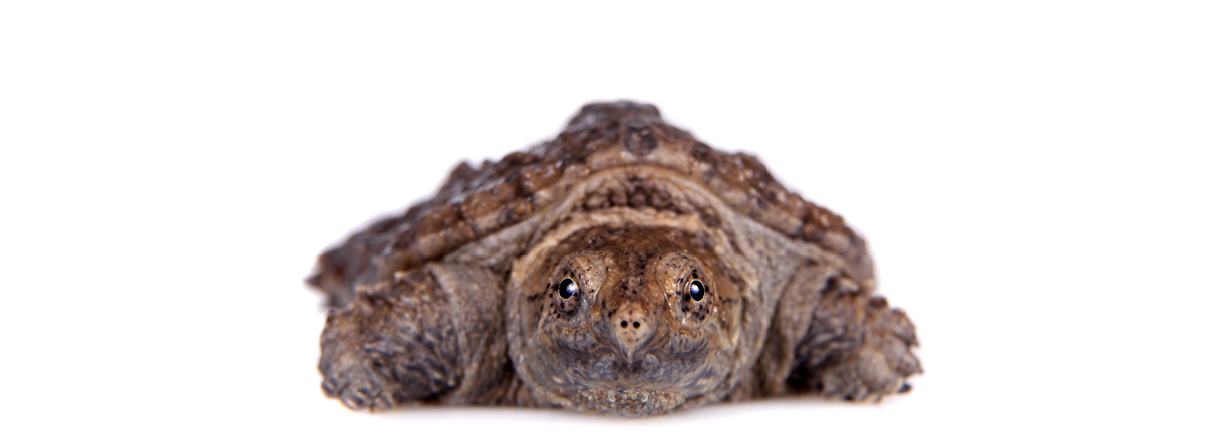
| The alligator snapping turtle invites fish over for dinner | True: This large snapper has a small, wormlike tongue, which it wiggles to invite fish into its large jaws, so it can eat them for dinner. (See: All About Turtles [2000] by Jim Arnosky) |
| Turtles cannot come out of their shells completely | True: Their shells are actually part of their skeletons and grow from their backbones; it would kill a turtle to separate it from its shell. (See: Turtles [2003] by Deborah Dennard) |
| During winter in cold climates, some turtle species can survive by hibernating and “butt breathing” | True: During the winter, turtles slow their metabolism way down so they do not need lots of energy or oxygen in the first place. Then, instead of using their lungs, they get their oxygen by pumping pond water into and out of special air sacs near their butts. This area has many blood vessels to absorb oxygen, thus butt breathing. The technical term for this is “cloacal respiration.” |
| Tortoises, like aquatic turtles, are generally good swimmers | False: Tortoises live on land and are usually not great swimmers. In Florida, well-meaning people have mistaken land-dwelling gopher tortoise hatchlings for sea turtles, since both lay their eggs in the same dunes near the sea. Because tortoises don’t swim well, putting them in the water puts them in danger. Sea turtles have flippers and gopher tortoises have toes with claws, so it is easy to tell them apart. |
| Some turtles have soft shells | True: The leatherback sea turtle does not have a hard shell but one made of tough, leathery skin. Adult leatherbacks do not have “scutes” [or large scales] as hard-shelled turtles do. The smooth softshell turtle, a Wisconsin species adapted to large rivers, lives in the Mississippi, Chippewa, lower Black and lower Wisconsin rivers. |
| Many turtle species face the threat of becoming extinct | True: Unfortunately, about half of all turtle species are “vulnerable, endangered, or critically endangered” according to the definitions of the International Union for the Conservation of Nature (IUCN). |
| We cannot do anything to stop turtles from going extinct | False: Human behavior — from human-caused climate change to littering — is the major threat to turtles, but humans can also make positive changes to help turtles. There are many organizations devoted to helping turtles survive and thrive. (See a list of some of these organizations in the “To Learn More About” section.) |
Read
Here are some suggestions from the Wisconsin Water librarians, but feel free to swap out with your own or visit our subject-specific reading list: Turtles.
Book descriptions are quoted, as noted below, from the Cooperative Children’s Book Center (CCBC), Publishers Weekly (PW), School Library Journal (SLJ) or BookLoons.com (BL)
It is lovely to start with a poem. This is one of our favorites.
“Into the Mud” by Joyce Sidman
Sun
slants low,
chill seeps into black
water. No more days of bugs
and basking.
Last breath, last sight
of light and down I go, into the mud.
Every year, here, I sink and settle, shuttered like a
shed. Inside, my eyes close, my heart slows
to its winter rhythm. Goodbye, good-bye!
Remember the warmth.
Remember the quickness.
Remember me.
Remember.
“Into the Mud” from Song of the Water Boatman & Other Pond Poems (2005) by Joyce Sidman illustrated by Beckie Prange.
“Caldecott Honoree McLimans gives this retelling of a Huron creation myth a contemporary look with the use of crisp, Native American-style motifs in bold primary colors …” (PW) For ages 4-8.
“A rhythmic, rhyming countdown book descends from ten to one as various other creatures startle or lure each turtle into the water … The author/illustrator also provides brief information about each of the creatures and instructions for making leaf prints, one of the techniques used in creating the artwork.” (CCBC) For ages 3-6.
“A rhyming and repetitive text with an easy f low conveys equal parts entertainment and information. Oversized pages with boldly-outlined illustrations add drama to the ancient creature’s [a primeval sea turtle] story.” (CCBC) For ages 3-8.
“An engaging, informative picture book chronicles a sea turtle’s first twenty years of life, underscoring some of the threats to this endangered creature, as well as some of the ways people help protect it. April Pulley Sayre’s finely paced narrative, full of both quiet moments and drama, is perfect for reading aloud.” (CCBC) For ages 4-9.
“Stewart’s message highlights the existence of a wide range of species and their ecosystems from bog turtles to desert tortoises to leatherback sea turtles … Maps, ‘Do’s & Don’ts,’ and website resources are helpful additions to this environmental awareness classroom resource.” (SLJ) For ages 6-9.
“From the moment Turtle first sticks his head out of his shell in the morning, he must respond both to his own needs and to other animals in his environment. Florian takes full advantage of all the drama pageturning provides as he depicts with skillful simplicity a typical day in a turtle’s life.” (CCBC) For ages 18m-3.
“Endpapers the color of a July sun invite readers to a dynamically presented year-round exploration of wild and domestic creatures. Seventeen poems and accompanying watercolor and line drawings bring the year to life in a new way. The poetic images characterizing the creatures by sound, rhythm, and season show Singer’s stunning mastery of words.” (CCBC) For ages 7-12, poetry.
“Forty-one short, unrhymed poems create a continuous narrative describing a day in the marsh. ‘Black snake/slides up/stealing/ the sitting rock’s/sun.’ Delicate black pencil drawings extend each poem visually and evoke realistic aspects of nature. Distinctive page layouts provide contrast and variety to a collection for individual sampling or reading aloud.” (CCBC) For ages 5-14, poetry.
“Resplendent full-color gouache paintings provide a turtle’s-eye view of a typical day at the edge of Long Pond. A passing chipmunk, a gentle rain and a feeding raccoon contribute to the subtle drama of life in the natural world.” (CCBC) For ages 3-5.
“When a painted turtle first hatches from its egg, it’s only the size of a quarter. Rick Chrustowski describes how the hatchling hides from danger at the water’s edge, feeding on beetle larva, minnows, tadpoles, and water bugs. In winter, she burrows in the mud and rests in a state similar to hibernation. … Illustrations that capture the beauty of the painted turtles and their watery habitat accompany the straightforward description of their habits and life cycle.” (CCBC) For ages 5-9.
“Facts about and descriptions of several turtle species are presented, from the proper terms for their ‘shells,’ to diet, size, hibernation, and egg clutching and hatching. Illustrations are clearly identified, as the text outlines the factors involved in turtles’ longevity as individuals and as a taxonomic order, in a vocabulary and style accessible to newly independent readers.” (CCBC) For ages 6-9, informational picture book.
“Max and his mother are volunteer members of a group that patrols the beaches in fall and winter, attempting to rescue Kemp’s ridley turtles, who enjoy the warm bays and lush food supply of Cape [Cod] in summer but become incapacitated and die after cold weather arrives. This photo-documentary account of the endangered Kemp’s ridley turtle successfully alternates its focus from the turtle discovered by Max to the status of the species …” (CCBC) For ages 7-11.
“… Yertle the Turtle, king of a ‘nice little pond’, gets ambitious: ‘I’m Yertle the Turtle! Oh, marvelous me! / For I am the ruler of all that I see!’ He commands an ever larger turtle-stacked throne so he can see more and more. At the very bottom, ‘a plain little turtle called Mack’ complains of pain and hunger, saying ‘I know up on top you are seeing great sights, / But down at the bottom we, too, should have rights.’ It seems only fitting that Mack’s burp brings Yertle tumbling down into the mud, so that ‘all the turtles are free / As turtles and, maybe, all creatures should be.'” (BL) For ages 4-8.
“[Clee’s pet] turtle, which spent early autumn sunning in the sandbox, begins burrowing under leaves for warmth. Clee’s mother advises her to bring the turtle in at night, but Clee does not, and on a cold November day she finds the turtle in the compost pile, ‘stone still, stone cold.’ Heartbroken, she buries the turtle deep within the compost heap. But there is a happy surprise in store for Clee in this tender story that also depicts the funny, warm and subtly changing relationship between Clee and her baby brother …” (CCBC) For ages 4-8.
Sing
Use any song you like adapted to the theme of turtles. Here are a few suggestions.
SING: Counting Turtles Song
1 baby turtle alone and new,
Finds a friend, and then there are 2.
2 baby turtles crawl down to the sea,
They find another, and then there are 3.
3 baby turtles crawl along the shore,
They find another, and then there are 4.
4 baby turtles go for a dive,
Up swims another, and now there are 5.
FINGER PLAY: Little Turtle
There was a little turtle
That lived in a box. (Put hands together to make a box.) He swam in a puddle. (Make
swimming movements.) And he climbed on the rocks.
He snapped at a mosquito. (Snap your fingers.) He snapped at a flea. (Snap your fingers.)
He snapped at a minnow. (Snap your fingers.) And he snapped at me. (Snap your fingers.)
He caught the mosquito. (Clap.)
He caught the flea. (Clap.)
He caught the minnow. (Clap.)
But he didn’t catch me!! (Make a proud face.)
SING: Turtles Everywhere
TUNE: “ON TOP OF OLD SMOKEY”
Some turtles swim over the ocean. Some turtles swim over the sea.
Some turtles grow very big, as big as you and me.
Turtles, turtles, swimming here and there. Turtles, turtles, turtles everywhere.
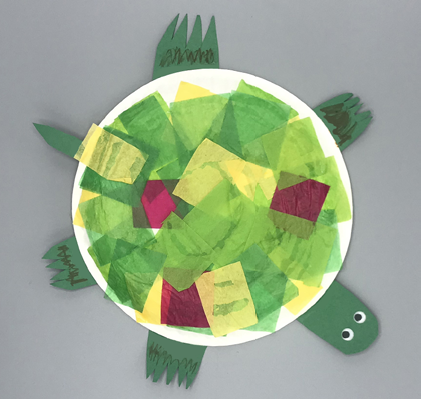
Craft: Paper Plate Turtle
Supplies:
Paper plates
Construction paper
Scissors
Googly eyes
Markers/crayons
Cups to hold markers/crayons
Glue
Yarn
How to
Create a turtle using paper plates, construction paper, torn pieces of
crepe paper, markers and glue. It’s a good idea to pre-cut the construction
paper (turtle heads and limbs) and tear the crepe paper ahead of time,
so the children just have to assemble them.
Turtles Native to Wisconsin
| Special Concern (*) | Species about which a problem of abundance or distribution is suspected but not yet proved. The main purpose of this category is to focus attention on certain species before they become threatened or endangered. |
| Endangered (**) | Any species that is in danger of extinction throughout all or a significant portion of its range |
| Threatened (***) | Any species that is likely to become endangered within the foreseeable future throughout all or a significant portion of its range. |
There are 11 turtle species in Wisconsin:
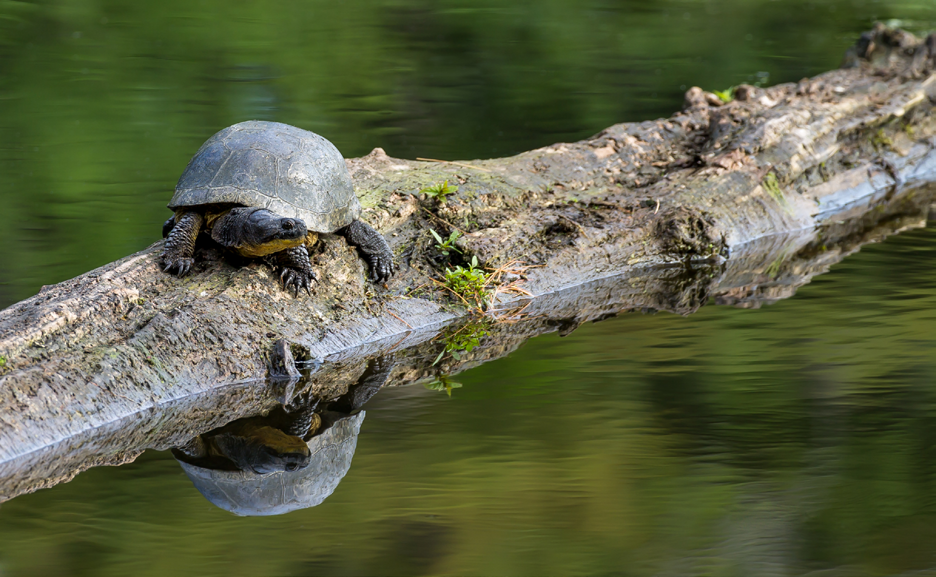
Blanding’s Turtle*
Eastern Musk Turtle
False Map Turtle
Northern Map Turtle
Ornate Box Turtle**
Painted Turtle
Smooth Softshell*
Snapping Turtle
Southern Map Turtle
Spiny Softshell
Wood Turtle***
Learn More About Turtles and Turtle Conservation
-
Turtles of Wisconsin (WI DNR)
-
FAQs about Turtles (WI DNR)
-
Britannica Turtle Facts
-
Live Science Turtle Facts
-
Environmental Education for Kids (EEK!)
-
Wisconsin Herpetological Association
-
Wisconsin Turtle Conservation Program
-
Turtles for Tomorrow
-
Project Wild
-
Partners in Amphibian and Reptile Conservation (PARC)
-
Midwest PARC Chapter
-
Sea Turtle Conservancy
-
Turtle Survival Alliance
-
“The Science of Saving the Blanding’s Turtle” video
-
Society for the Study of Amphibians and Reptiles
-
SSAR Resources and Education